
Legal Cyber Academy

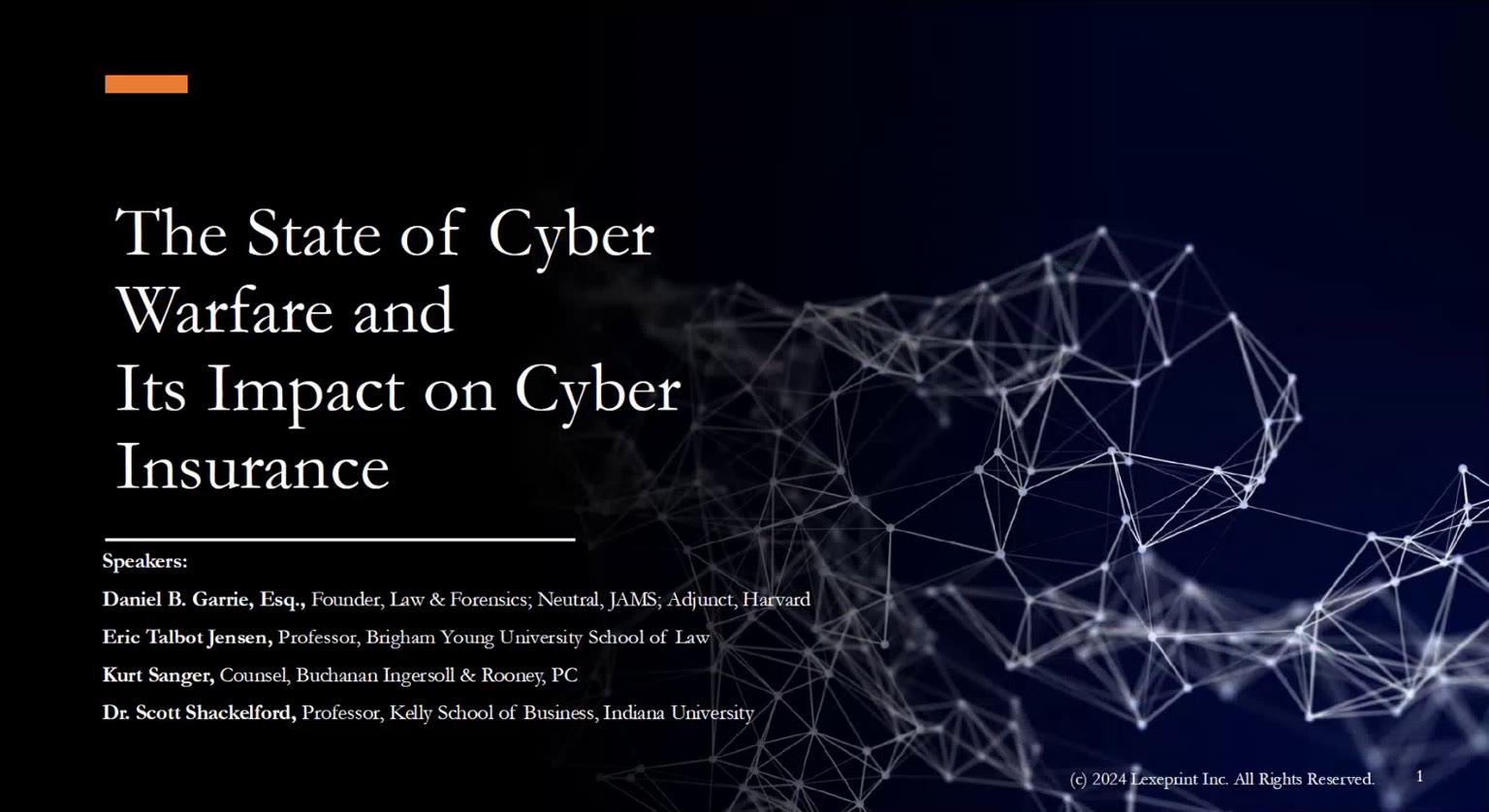
The State of Cyber Warfare and Its Impact on Cyber Insurance

Taught by Daniel B. Garrie, Eric Talbot Jensen and 2 others

InsuranceLevel: Intermediate1h 7m

Overview of The State of Cyber Warfare and Its Impact on Cyber Insurance

A panel discussion on how cyber operations by states and non-state actors are treated under international law and why that matters for cyber insurance. It begins with the current threat landscape and the asymmetric advantages cyber operations offer, then turns to the UN Charter's prohibition on the use of force, prohibited intervention, and the threshold for an armed attack. The discussion then covers how the law of armed conflict applies once a cyber operation occurs within an existing conflict, how first-party and third-party cyber coverage works, and why the war exclusion has become a central point of dispute, including the difficulty of attribution and of defining war or hostile action. The program reflects the law as it stood when it was recorded; confirm current rules before relying on it.

What you’ll learn in The State of Cyber Warfare and Its Impact on Cyber Insurance

  • Describe the threat landscape and why cyber operations favor state and non-state actors
  • Explain the international law thresholds for prohibited intervention, use of force, and armed attack as applied to cyber operations
  • Summarize how first-party and third-party cyber insurance is structured
  • Identify why the war exclusion and 'hostile or warlike action' language cause coverage disputes

Audience and prerequisites

Who should take this course — The State of Cyber Warfare and Its Impact on Cyber Insurance

Attorneys advising on cyber insurance coverage, in-house counsel managing cyber risk, and professionals working on cybersecurity policy or international law.

Prerequisites for The State of Cyber Warfare and Its Impact on Cyber Insurance

None. Familiarity with cyber insurance concepts is helpful.

Curriculum

  1. 1. The Digital Arms Race and Today's Threat Landscape

    Opens with today's cyber threat landscape, including how stolen data is bought and sold on illicit markets, then sets up the international law questions that follow.

    Watch The Digital Arms Race and Today's Threat Landscape
  2. 2. International Law: Intervention, Use of Force, and Armed Attack

    Explains prohibited intervention and the UN Charter's bar on the threat or use of force, and why armed attack is the threshold for self-defense, including how poorly existing law fits cyber operations.

    Watch International Law: Intervention, Use of Force, and Armed Attack
  3. 3. Private-Sector Exposure and the Tallinn Manual

    Examines how the private sector bears the brunt of cyber conflict, how the law of armed conflict and the Tallinn Manual apply, and the conflicting legal obligations multinational companies face.

    Watch Private-Sector Exposure and the Tallinn Manual
  4. 4. Cyber Insurance and the War Exclusion

    Explains how the war exclusion in cyber insurance works, why policies define it differently, and why the lack of a clear policy definition leaves businesses unsure of their coverage.

    Watch Cyber Insurance and the War Exclusion
  5. 5. Hostile or Warlike Action: Attribution and Coverage Disputes

    Examines what counts as a hostile or warlike action under a war exclusion, why attribution is so difficult, and how coverage disputes can turn on a few words, with examples tied to the war in Ukraine.

    Watch Hostile or Warlike Action: Attribution and Coverage Disputes

Your instructors

Portrait of Daniel B. Garrie

Daniel B. Garrie

Founder, Law & Forensics; Neutral at JAMS; Faculty at Harvard

Daniel B. Garrie is the founder and executive managing partner of Law & Forensics LLC, a boutique cybersecurity and forensic engineering firm he co-founded in 2008. He serves as a neutral, arbitrator, and forensic special master at JAMS, focusing on cybersecurity, cryptocurrency, and complex technology disputes, and holds faculty appointments at Harvard and Rutgers Law School. A patented software inventor and prolific author, he is editor-in-chief of the Journal of Law & Cyber Warfare and a widely cited authority on computer forensics, eDiscovery, and cyber litigation.


Eric Talbot Jensen

Robert Barker Professor of Law, Brigham Young University Law School

Eric Talbot Jensen is the Robert Barker Professor of Law at Brigham Young University Law School and an expert in the law of armed conflict, public international law, national security law, and cyber warfare. He served twenty years in the United States Army as a cavalry officer and judge advocate, including as chief of the Army's International Law Branch, deputy legal advisor for Task Force Baghdad, and professor of International and Operational Law at The Judge Advocate General's Legal Center and School. He served for a year as special counsel to the Department of Defense General Counsel, and taught for two years at Fordham Law School before joining the BYU faculty in 2011. Jensen was one of the group of experts who prepared the Tallinn Manual on the International Law Applicable to Cyber Warfare and has published more than thirty law journal articles. At Legal Cyber Academy, Eric Talbot Jensen teaches on cyberwar and its legal implications under international law.

Kurt Sanger

Founder and Director, Integrated Cybersecurity Partners, LLC; Cybersecurity and Data Privacy Attorney, Buchanan Ingersoll & Rooney PC

Kurt Sanger is founder and director of Integrated Cybersecurity Partners, LLC, a cyber and national security consultancy, and is a cybersecurity and data privacy attorney with Buchanan Ingersoll & Rooney PC. He served with U.S. Cyber Command from 2017 to 2022, first as lead attorney for plans, policy, partnerships and legislative affairs, then for operations and intelligence, and finally as the command's deputy general counsel; from 2014 to 2017 he was general counsel for U.S. Marine Corps Forces Cyberspace Command. Over more than 23 years of active duty in the Marine Corps he served as a prosecutor, criminal defense counsel, cyber operations attorney and international law instructor, retiring in November 2022. He holds a degree in national security law from Georgetown University and is a non-resident senior associate with the CSIS Strategic Technologies Program and a non-resident fellow with the Army Cyber Institute at West Point. At Legal Cyber Academy, Kurt Sanger teaches on limiting an organization's ransomware risk from a legal perspective.

Scott Shackelford

Provost Professor of Business Law and Ethics, Kelley School of Business, Indiana University

Scott J. Shackelford is Provost Professor of Business Law and Ethics at the Indiana University Kelley School of Business, and serves as Associate Vice President and Vice Chancellor for Research at Indiana University Bloomington. He is Executive Director of both the Ostrom Workshop and the Center for Applied Cybersecurity Research. His listed areas of expertise are cybersecurity and privacy, international law and relations, property, and sustainability, and his books include Managing Cyber Attacks in International Law, Business, and Relations: In Search of Cyber Peace (Cambridge, 2014), The Internet of Things: What Everyone Needs to Know (Oxford, 2020) and Forks in the Digital Road: Key Decisions that Gave Us the Internet We Have (Oxford, 2024). He holds a J.D. from Stanford and a Ph.D. in politics and international studies from the University of Cambridge. At Legal Cyber Academy he teaches on cyberwar.